
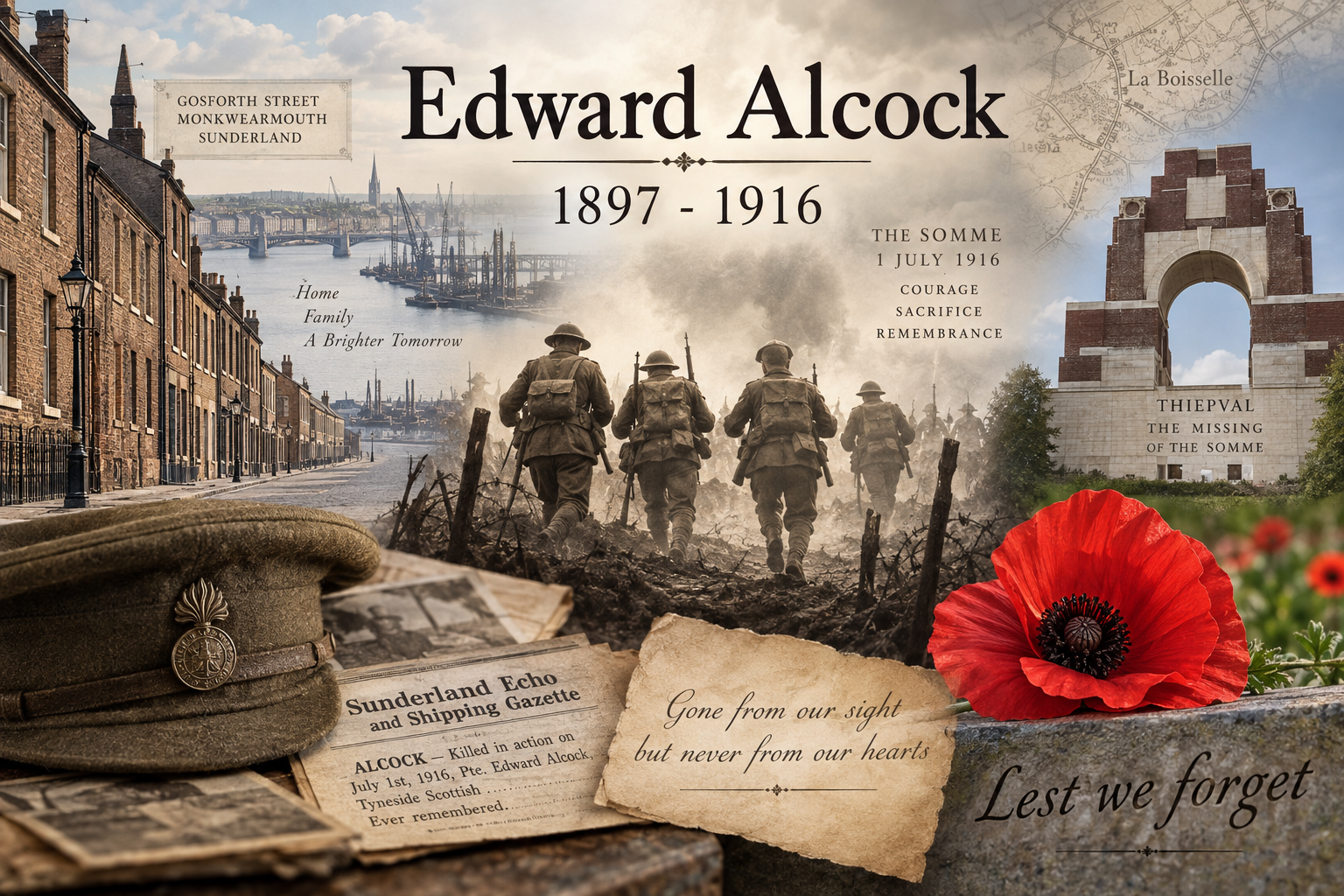
Growing Up in Monkwearmouth
Edward Alcock was born around July 1897 in Monkwearmouth, Sunderland, the son of James Broom Alcock and Sarah Ann Inness. He grew up in a part of Sunderland shaped by shipbuilding, the River Wear and the busy industrial life of Wearside.
The 1901 Census finds three-year-old Edward living with his family at 57 Gosforth Street, Monkwearmouth, in a household of eight people. Ten years later, in 1911, the family were still living on Gosforth Street, this time at number 58. Edward was thirteen and recorded as a scholar.

These were the streets and surroundings that Edward would have known as a child. Monkwearmouth was a closely settled working-class community, where families lived close to one another and where the sounds of Sunderland’s industries were part of everyday life. The River Wear, the docks, shipyards and factories provided employment for generations of local families.
For Edward, childhood would have been spent among his brothers and sisters, neighbours and friends, growing up in a community where people knew one another and shared many of life’s experiences.
But Edward belonged to a generation whose childhood was overshadowed by an event that would change Britain forever.
The Coming of War
When Britain entered the First World War in August 1914, Edward was about seventeen years old.
The declaration of war was felt particularly strongly in Sunderland. Thousands of local people gathered in the town centre looking for news as the crisis in Europe unfolded. When news finally came that Britain had declared war on Germany, the Sunderland Echo reported that there was initially silence before cheers and singing broke out among the crowds.
Across Wearside, young men were encouraged to enlist and serve their country. Recruitment meetings were held at places such as Victoria Hall, and Sunderland’s young men answered the call in large numbers. Around 20,000 men from Wearside eventually served in the British Army during the First World War.
Edward was part of this generation.
Some men joined because they felt it was their duty. Others were influenced by friends, brothers or the pressure of their communities. For a young man of Edward’s age, military service could also seem like an opportunity for adventure and a chance to prove himself.
Whatever Edward’s personal reasons for enlisting, his decision would take him far from the streets of Monkwearmouth and into one of the most terrible battles of the war.
The Tyneside Scottish
Edward served as Private Edward Alcock, 22/1152, in the 22nd Battalion, Northumberland Fusiliers – the 3rd Tyneside Scottish.
The Tyneside Scottish battalions were closely connected with the North East. They were part of the 102nd Brigade of the 34th Division, alongside other Tyneside Scottish battalions.
For men from Sunderland and the surrounding North East communities, these were not simply military units. They were local formations containing men from the towns, streets and neighbourhoods they knew.
Edward would have served alongside men who may have shared similar backgrounds to his own – men from the North East who had grown up in the same industrial landscape of shipyards, docks, mines and working-class streets.
By 1916, however, the excitement and patriotism that had accompanied the beginning of the war had given way to the grim reality of trench warfare.
France and the Somme
By the summer of 1916, Edward was serving in France.

The British Army was preparing for a major offensive on the Somme. Behind the British lines, an enormous artillery bombardment had been taking place in preparation for the attack. On 1 July 1916, British and French forces launched the offensive that would become known as the Battle of the Somme.
It was to be one of the bloodiest battles of the First World War.
The first day alone resulted in approximately 20,000 British soldiers killed and another 40,000 wounded. The scale of the casualties was almost unimaginable. Sunderland was particularly affected: more than 170 Wearside soldiers were killed on the first day alone, while more than 500 Sunderland-born men died during the Somme offensive as a whole.
Among them was Edward.
1 July 1916 – The Battle of La Boisselle
On the morning of 1 July 1916, Edward’s battalion took part in the attack near La Boisselle.

The Tyneside formations of the 34th Division faced exceptionally difficult fighting that day. The 102nd Brigade suffered such heavy casualties during the attack at La Boisselle that the brigade was subsequently attached to another division for a period after the battle.
The opening phase of the Somme was marked by the tremendous scale of the fighting. Soldiers had to advance across ground exposed to machine-gun and artillery fire, while the German defensive positions had been heavily fortified.
For Edward, this was not a battle remembered simply as a date in a history book. It was the day on which his life ended.
He was killed in action on 1 July 1916.
Edward was only about 18 years and 10 months old.
A young man who had grown up on Gosforth Street in Monkwearmouth was now lying somewhere on the battlefields of France.
The Silence That Followed
For Edward’s family, the terrible news did not necessarily arrive immediately.
Initially, he was reported as missing.
This must have left his parents, James and Sarah, caught between hope and fear. A missing soldier could still be alive. Families waited for letters, news from returning soldiers and any small piece of information that might tell them what had happened.
The uncertainty could last for months.
Eventually, the family learned the truth: Edward had been killed in action on 1 July 1916.
The date itself would have been painfully significant. It was the first day of the Somme, a day when thousands of British families across the country were beginning to lose sons, brothers, husbands and friends.
For the Alcock family, the war had suddenly become deeply personal.
A Family’s Grief
On 12 February 1917, several touching memorial notices appeared in the Sunderland Echo and Shipping Gazette.
They reveal something that official military records cannot – how deeply Edward was loved and how many people felt his absence.
His parents remembered him as their “dearly beloved” son. His brothers and sisters remembered their youngest brother. Nephews and nieces remembered their uncle. Friends remembered their pal.
One tribute speaks of the “vacant chair” left behind.
Another remembered the pain of never having had the chance to hear his final words.
These were not simply formal announcements of a soldier’s death. They were expressions of a family trying to put their grief into words.
Edward had not been forgotten.
His name appeared again and again in the notices, surrounded by the names of the people who had loved him.
His family remembered not Private Alcock, number 22/1152, but Edward – their son, brother, uncle and friend.
Remembering Edward
Edward has no known grave.
Like so many men who died during the opening day of the Somme, his final resting place was never identified. His name is therefore commemorated on the Thiepval Memorial to the Missing of the Somme, which remembers thousands of men who died in the Somme sector and have no known grave.
Today, the Thiepval Memorial stands as a vast reminder of the human cost of the battle.
Edward’s name is there among the thousands.
But for his family in Sunderland, his name would have meant something very different.
It belonged to the boy who had grown up on Gosforth Street.
The little brother.
The son who had left home to serve his country.
The friend whose absence left an empty place among those who knew him.

A Young Life Cut Short
Edward Alcock’s story is one of thousands from Sunderland and the North East during the First World War, but within his own family it was unique.
He had barely reached adulthood.
He had grown up in Monkwearmouth, surrounded by family and the familiar streets of home. At a time when young men were being called upon to serve, Edward became one of those who left Sunderland for the battlefields of France.
On 1 July 1916, his young life came to an end at La Boisselle.
The Battle of the Somme would continue for months, and the names of thousands more men would eventually be added to memorials across France. But for Edward’s parents, brothers, sisters, nephews, nieces and friends, the war would always have one particular face.
Edward Alcock.

And although more than a century has passed since his death, the words written by his family in 1917 still convey the depth of their loss.
He was loved.
He was mourned.
And, as their memorial notices made clear, he was never forgotten.
Edward Alcock
1897–1916
22/1152, 22nd Battalion, Northumberland Fusiliers
3rd Tyneside Scottish
Killed in action, 1 July 1916
Commemorated on the Thiepval Memorial, Somme, France