
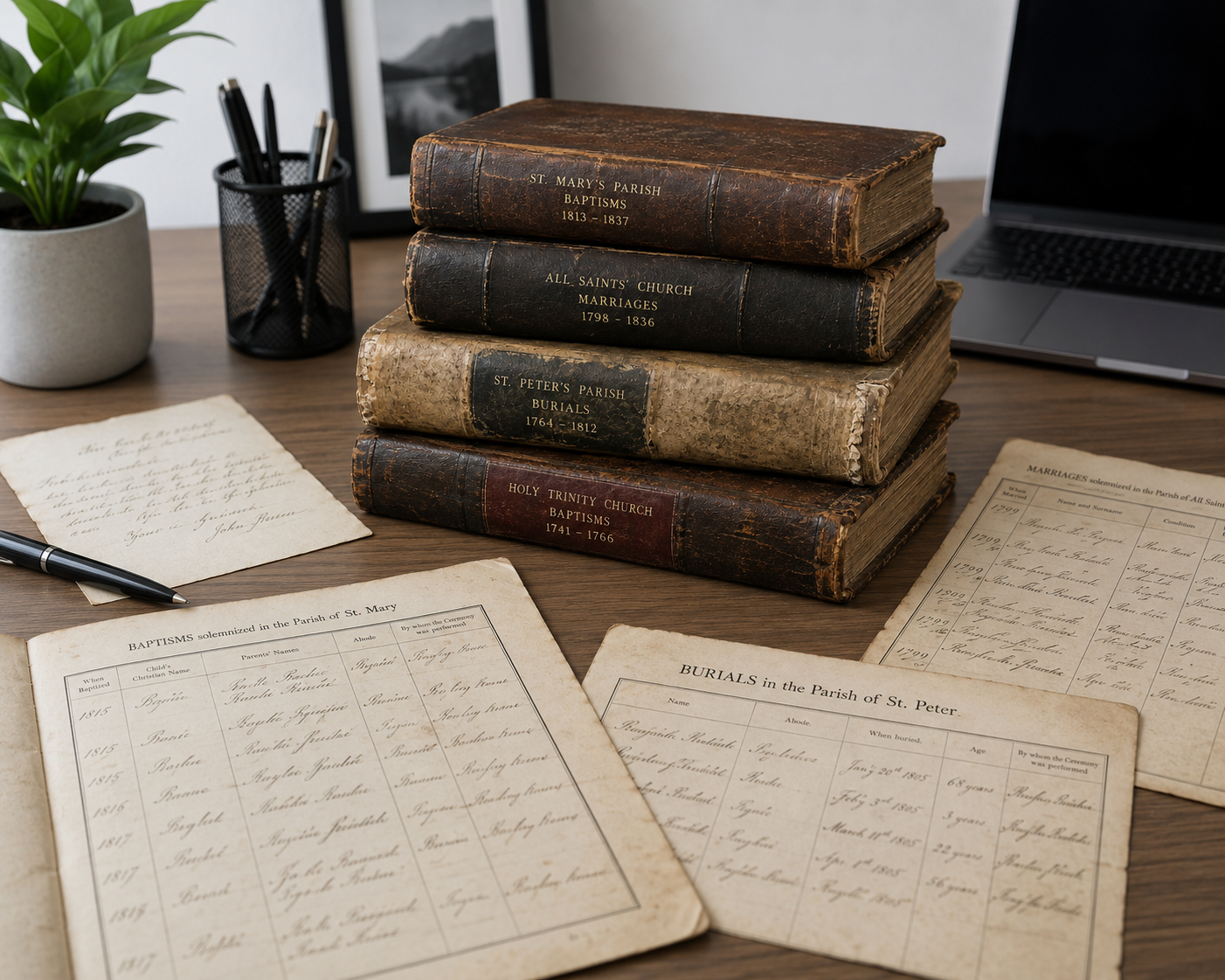
If you’re beginning your family history journey, you’ll quickly discover that parish records are among the most valuable resources available. Long before governments kept official records of births, marriages, and deaths, local churches were responsible for recording many of the most important events in people’s lives. For genealogists, these records provide an invaluable window into the past.
What Are Parish Records?
Parish records are documents created by local churches to record key events within the parish. The most familiar are the parish registers of baptisms, marriages, and burials, but many parishes also kept a wide range of other records that reveal fascinating details about the lives of ordinary people.
Following an order issued in 1538 by Thomas Cromwell, parish priests in England were instructed to keep registers of baptisms, marriages, and burials. Although not every register has survived, many date back to the sixteenth century, making them some of the oldest continuous records available to family historians.
Why Are Parish Records So Important?
Parish records often provide the evidence needed to identify ancestors before the introduction of civil registration in England and Wales in 1837. They can help you:
- Identify parents, spouses, and children.
- Confirm family relationships.
- Estimate birth and death dates.
- Discover where an ancestor lived.
- Learn occupations and social status.
- Trace families across several generations.
- Distinguish between individuals with the same name.
Because parish records were created at or near the time of an event, they are generally considered reliable sources. However, like any historical record, they are only as accurate as the information supplied and the care taken by the person recording it. Comparing information from several sources is always good genealogical practice.
The Main Types of Parish Records
Baptism Records
Baptism records are often the earliest surviving record of an ancestor. Depending on the period, they may include the child’s name, baptism date, parents’ names, residence, father’s occupation, and occasionally the child’s date of birth. Some Catholic registers also contain later annotations recording events such as confirmation or marriage.
Marriage Records
Marriage records can be particularly informative. In addition to the names of the bride and groom, later registers may record their ages, occupations, residences, fathers’ names and occupations, whether the marriage was by banns or licence, and the names of witnesses. Witnesses were often relatives and can provide valuable clues when researching extended families.
Burial Records
Burial records usually record the date of burial and the name of the deceased. Later entries may also include age, residence, occupation, marital status, and family relationships. These records are especially useful for estimating birth years and identifying family groups.
Parish Records Go Beyond Baptisms, Marriages, and Burials
Many people are surprised to learn that parish collections contain much more than the three main registers. Depending on the parish, you may also find:
- Settlement and removal records
- Poor law records
- Churchwardens’ accounts
- Vestry minutes
- Bastardy examinations
- Apprenticeship records
- Overseers’ accounts
- Monumental inscriptions
- Church seating plans (pew rentals)
- Tithe records
These records can provide remarkable insights into the everyday lives of your ancestors, revealing their occupations, financial circumstances, disputes, and movements between parishes.
Always Look for the Original Record
Many parish records are now available online as searchable indexes or transcriptions. These are excellent finding aids, but they should not be regarded as a substitute for the original register. Transcriptions can contain errors or omit details such as occupations, residences, marginal notes, or witnesses. Whenever possible, view the original image to ensure you capture every available clue.
FINAL THOUGHTS
Parish records are the backbone of British genealogy. They not only document births, marriages, and deaths but also tell the story of communities and the people who lived in them. Whether you’re tracing your ancestors back to the Victorian era or the Tudor period, parish records often provide the key that unlocks the next generation.
If you’re serious about researching your family history, learning how to locate and interpret parish records is one of the most valuable skills you can develop. They remain one of the richest and most rewarding sources for discovering the lives of our ancestors.
Leave a Reply